Adoption
Consumer apps already move USDC
Block's Cash App sends and receives USDC on Solana, Ethereum, Polygon and Arbitrum: a payments company running four chains under bank-grade compliance obligations.
No custody · No keys
ALLOW, REVIEW or DENY, with evidence, before an institution credits a deposit, links a wallet or signs a transfer. On top of the screening vendors you already pay for.
For banks, custodians, EMIs and licensed crypto-asset service providers.
Not signed. Case opened at L2; out-of-band verification with the customer must be recorded first.
Why · 12 rules evaluated, 3 fired
R-ATO-301Credentials changed 0.5h ago, then a new deviceREVIEWR-ATO-304Destination added 12 min ago; 60-minute cooling-offREVIEWR-VEL-310Withdrawal 5.3× the 30-day averageREVIEW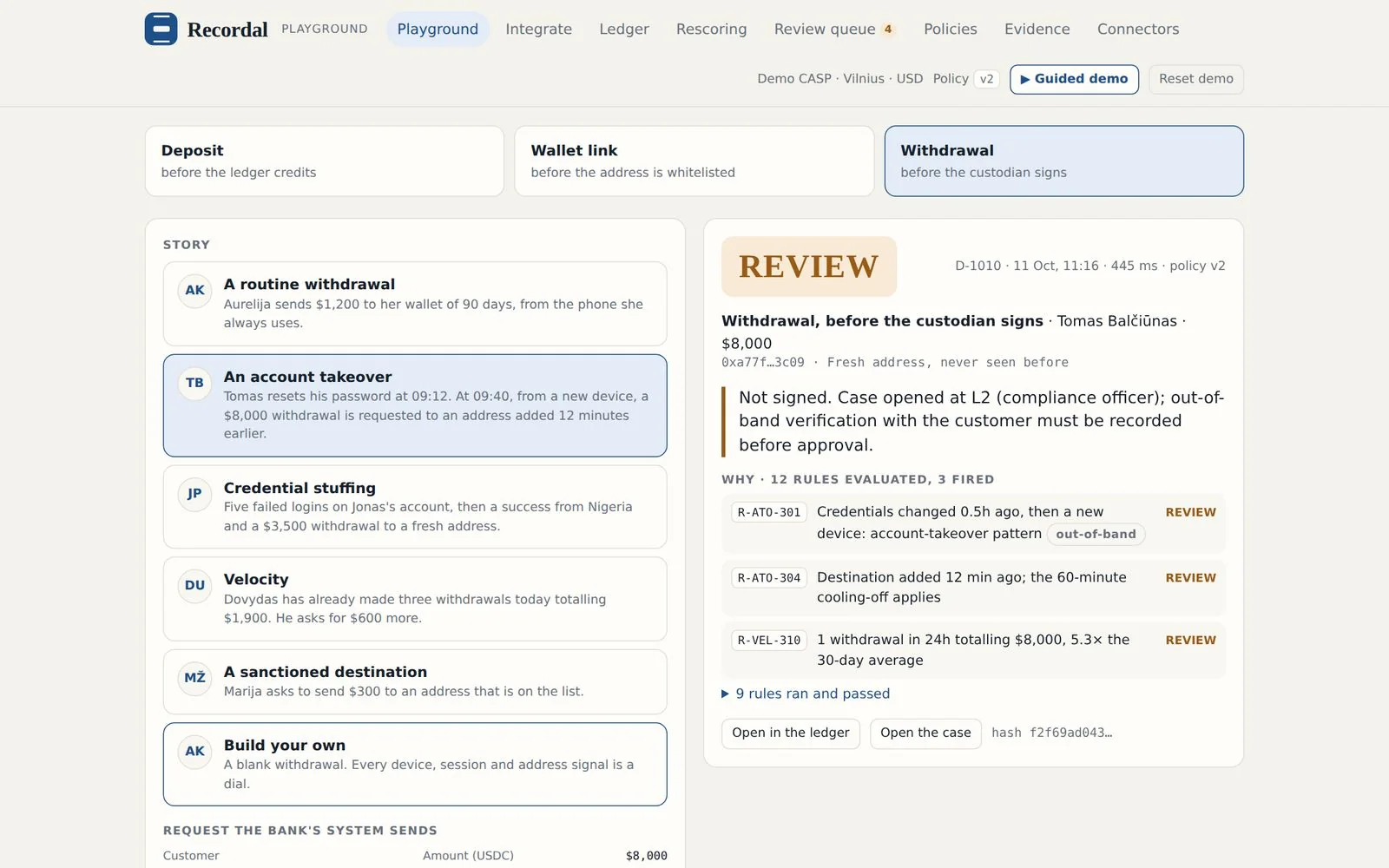


View full screenshot ↗Recordal prototype, October 2026. Vendors and AI output simulated and labelled; the engine, policy versioning, rescoring path and evidence log are real.
Sits above the vendors and systems you already run
Connectors stay on your own contracts. Swap a vendor; keep the policy and the history.
01 Why now
The rails are live. The controls behind them still live in vendor dashboards, spreadsheets and screenshots.
Adoption
Block's Cash App sends and receives USDC on Solana, Ethereum, Polygon and Arbitrum: a payments company running four chains under bank-grade compliance obligations.
Risk
FATF's July 2026 update: most illicit on-chain activity now runs through stablecoins, the same assets institutions are adopting.
Regulation
EU Travel Rule, MiCA licensing, DORA, FinCEN's AML/CFT modernization rule and GENIUS Act stablecoin rules.
Every one of these flows now needs a decision a supervisor can inspect afterwards.
Per-transfer data checks at any amount; 3/5/7-working-day escalation; repeat failers reported within 3 months.
ICT risk, incident logging and oversight of third-party providers, screening vendors included.
Effective, risk-based programs with evidence of effectiveness; about 12 months to comply.
Transition periods are over. Licensed entities have supervisors who examine; the first examinations are happening now.
83% of jurisdictions have the law; 60% of those have not enforced it yet. Enforcement is the next wave.
Issuers must be able to block, freeze and reject; SAR duties in the primary market.
Sources: Cash App stablecoin documentation (2026); FATF Targeted Update on Virtual Assets, Jul 2026; EBA/GL/2024/11; MiCA Art. 143; DORA; FinCEN NPRM fact sheet, Apr 2026; GENIUS Act implementing proposals.
02 The gap
$40M
NYDFS consent order against Block, Inc., April 2025. Block had screening vendors. It lacked a policy of record: thresholds with a written rationale, decisions with evidence, and a queue that could not silently grow.
Source: NYDFS Consent Order, In the Matter of Block, Inc., 10 April 2025, paras 19 and 24.
The vendor
TRM, Chainalysis and Elliptic return risk scores and tags. They do not know the licence conditions, the risk appetite or the customer behind the transfer.
The institution
Thresholds in a spreadsheet, decisions in tickets and chat, evidence in screenshots: how over 70% of firms still document compliance.
The examiner
Asks for the rule in force that day, the evidence, and who signed off. 90% of regulators now check Travel Rule compliance in examinations.
Source: Notabene, State of Crypto Travel Rule 2025 (91 firms surveyed).
03 The product
Each with the rules that fired, the signals used and the vendor evidence attached.
Control point 1
An inbound transfer seen by the institution's chain watcher. Source exposure, Travel Rule data and customer risk are decided before the ledger credits.
Control point 2
A customer adds a withdrawal address. Ownership proof (the EU self-hosted wallet rule), sanctions and exposure are decided before it is whitelisted.
Control point 3
An outbound transfer. Account-takeover signals, limits and counterparty checks are decided before the custodian signs.
Recordal holds no keys and no funds. It returns the decision, the reasons and the evidence; your ledger or custodian executes.
04 How it works
Your vendors' answers become one canonical signal set. Your rules decide. Your systems execute.
TRM Labs or Chainalysis, ComplyAdvantage, core KYC and ledger, Sardine, the address book, Notabene.
Each vendor's answer mapped to one canonical signal; the raw field kept beside it. Swap TRM for Chainalysis without touching a rule.
Your rules, versioned and hashed. Every applicable rule runs.
ALLOW, REVIEW, DENY or PENDING, with reasons, signals and vendor reports.
Executes the decision. Recordal never touches funds or keys.
Tiered review queue
Hard rules cannot be overridden at any tier. Account-takeover cases need an out-of-band verification recorded first. Every action is logged.
Exam pack
For any decision, everything an examiner asks for, in one export.
05 System of record
Built so the answer stays right when the facts change, and so you can prove how you got there.
A missing input holds the request and retries. What happens next (hold, review or a low-value degraded mode) is a policy choice, recorded as a rule, never as a default.
No short-circuits. Every applicable rule evaluates and records its result, so the audit record is complete. Hard rules cannot be overridden by anyone.
Rules are versioned and hashed. Changes are simulated against history and need dual approval before they go live.
New intelligence, a vendor coming back or a new policy version re-runs every decision it touches. The original stays; the rescored one supersedes it, with a case if the answer changed.
Every decision and every review action lands in a hash-chained evidence log. Records can be added, never rewritten.
TRM or Chainalysis, ComplyAdvantage, Sardine, Notabene and your own systems, normalized into one signal set. Swap a vendor; keep the policy and the history.
06 Where AI fits
AI writes
Adapters from a sample payload. Policy changes from plain English. Case briefs, examiner explanations, SAR narrative drafts. A person approves every one.
The engine decides
Every ALLOW, REVIEW and DENY comes from fixed rules under a versioned policy. No model in the decision path, so every decision replays exactly.
The record proves it
Every decision, approval and accepted AI draft is hash-chained in the evidence log. An examiner sees who accepted what, and when.
Reads a sample from your custody or ledger system, maps each field to a signal, writes and tests the adapter; an engineer approves.
Weeks of integration work
“Review any deposit with 10% or more mixer exposure” becomes a drafted rule change, with what it would have changed on the ledger.
Engineering tickets for every threshold change
What happened, key facts, similar past decisions, the next step and a drafted analyst note.
Analyst minutes per case
The decision record in plain English, every sentence from a stored field; plus a SAR narrative draft.
Days rebuilding the answer by hand
Reads new rules and memos, says whether they touch your policy, and drafts the change.
Missed changes between reviews
07 Who it's for
Now supervised under MiCA and examined on Travel Rule and screening. Built to help you pass the first examination.
Custody, payments and deposits in stablecoins. The decision belongs inside your existing risk framework, not in a vendor dashboard.
Under the GENIUS Act rules from January 2027, block, freeze, reject and report capabilities become table stakes.
08 Getting started
One real flow (inbound stablecoin deposits), your own vendors, your thresholds written as rules.
We show the artifact an examiner will ask for, generated from your own decisions.
Decision before credit first; then wallet link and outbound signing.
More chains, vendors and entities as your book grows.
No custody. No keys. One answer, with the evidence attached, that stays right when the facts change.